
Volunteers’ work shows how a corporal work of mercy can be as simple as sharing time with someone
By Jay Sorgi
for the Register
Not a lot of people are doing anything on a Tuesday night at 6 p.m. besides eating dinner, according to Rob Huebert.
He and fellow member of Blessed Sacrament Parish in Lincoln, Dick Smith, have a different idea, following the path of the Virgin Mary visiting her cousin St. Elizabeth before her son Jesus, and Elizabeth’s son St. John the Baptist, were born.
They chose the route of corporal works of mercy, to visit people who don’t often have others make time for them, gathering as a weekly team of five to 10 or more volunteers to see senior residents in the long-term care area of Emerald Nursing and Rehab Lancaster, a three-minute drive from Blessed Sacrament.
“It’s simple, but simply sacrificing your time, and it’s not a lot,” Huebert said. “Giving up my own time to try to do something for other people is just something that I need to do more often. This gives me the opportunity.”
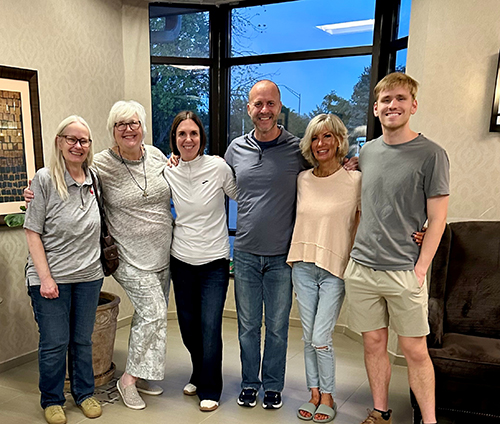
Smith, who co-leads the group with Huebert, said that the ministry stemmed from pastor Father Michael Morin traveling to Mexico on pilgrimage and visiting an assisted living center.
“He said, ‘It was so moving to go there and just to sit there and listen to people,’” Smith said. “It dawned on him. He’s like, ‘We don’t need to go to Mexico for this. We could do this in Lincoln.”
Father Morin suggested visiting the residents every Tuesday, and corralled Smith to help lead it. Smith got some help from Huebert, whose experience in social responsibility includes visiting the homebound, including nursing home residents, with the Eucharist.
“I was telling Father Morin that, and he said, ‘I have some good news for you. We have something that we’re trying to cook up. We’ve kind of been talking about getting the ball rolling on visiting Emerald,’” Huebert said.
“After that, it only took like two weeks, and then we started doing it.”
They named their ministry “Mary, Visitation of Hope” as a way of showcasing what just accompanying someone else’s journey can mean to them, like Mary did for her cousin in visiting her.
“One of the things about the Visitation is the sacrifice. Mary walks from Nazareth to Judea, and it’s [about] 100 miles. It takes her multiple days. She walks 100 miles with a caravan. She walks all the way there just to visit her,” Huebert said. “Think about that sacrifice. And we’re in a car and we have to drive (less than) five minutes.”
Their ministry is meeting the needs of people who perhaps average an hour or two of human interaction each day, mostly involving physical care.
“It really does bring you closer to Jesus Christ, through talking to people who are bedridden, wheelchair ridden, and they don’t see anybody throughout the day, except for people within Emerald Place,” Smith shared.
“They’ve all seen each other so much, you can tell that they’re kind of tired of talking to each other, and they want to talk to somebody else. They’re starving for that interaction.”
Huebert added that his career in physical therapy exposes him to understanding the daily interactions that a nursing home resident experiences.
“I feel that they rarely get real-life interactions,” he said. “I feel like a lot of them live a life where their entire life revolves around their health. Whenever someone comes into their room, it’s helping them get changed, helping them go to the bathroom, helping them take medicine, helping them eat, those kinds of things. That’s all their interactions are.”
Sometimes the interactions the visiting group members offer aren’t supremely heavy, but they often can become a chance for volunteers to act as missionary disciples.
“The interactions are pretty normal interactions that you would have on a day-to-day basis, just to kind of, kind of break the ice a little bit, either talking about the weather or football because of Husker football,” Smith said.
“They know we’re there from Blessed Sacrament, so various different topics will come up about the Catholic faith, and then we close out with a prayer, either their favorite prayer or a Hail Mary.”
Sometimes, giving a corporal work of mercy can be as simple as talking about the upcoming Nebraska game. Both Huebert and Smith believe that their team’s volunteers encounter the face of Christ every Tuesday night, simply by choosing to do something more than grab dinner at 6 p.m.
Corporal Works of Mercy: Feed the hungry; Give drink to the thirsty; Clothe the naked; Shelter the homeless; Visit the sick; Visit the prisoners; Bury the dead
“How many times do we walk through the day, and you walk by people all the time, and they could care less whether they want to talk to you,” Smith said.
“These people want to talk to you. They’re excited to talk to you. That’s the one thing I think people probably wouldn’t really realize is that you can really feel God’s grace by just being there for these people, the residents.”